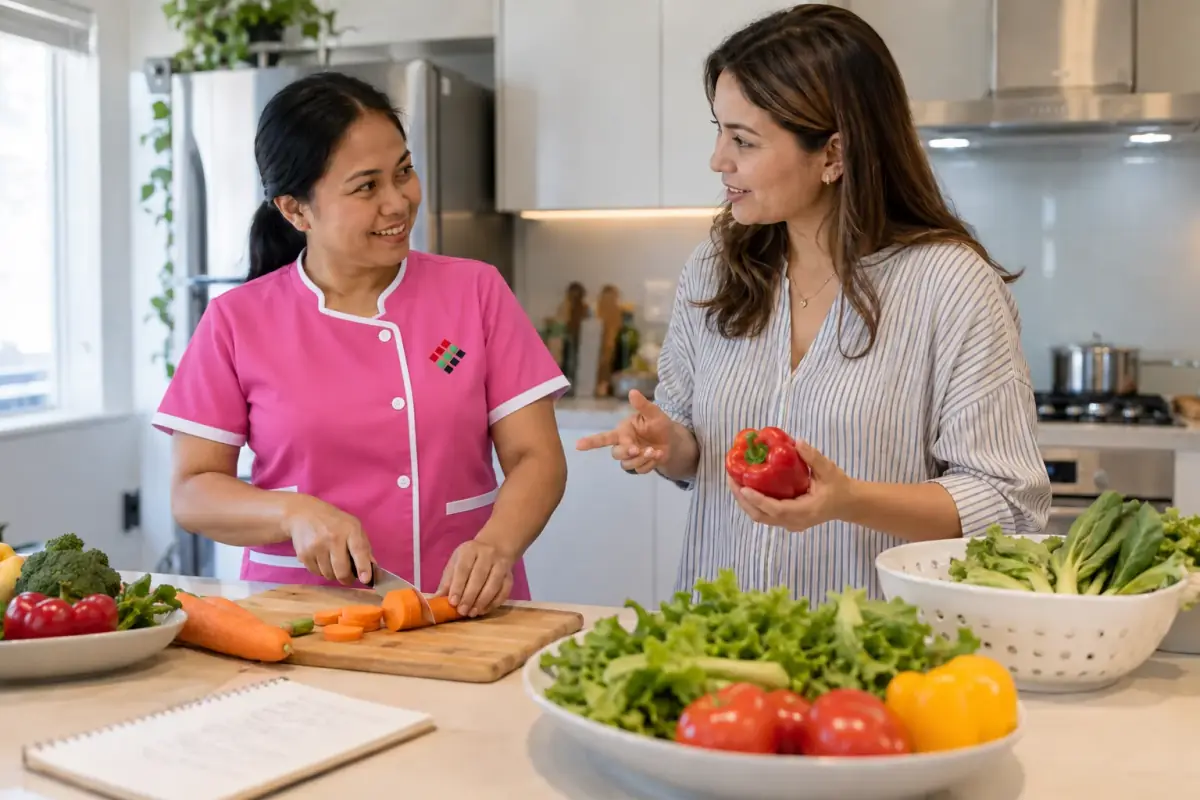
If you are searching for a Filipino maid in Ajman, make the enquiry about an individual person's experience and the communication your household needs. A nationality preference does not demonstrate English proficiency, childcare competence, cooking skills or availability. Use this task-communication workbook to discuss practical examples, clarify expectations and identify what your household will need to teach. Read the existing Philippines domestic-worker guide for the country-preference context; this article focuses on a fair, useful conversation.
Translate your preference into actual requirements
Ask yourself what you hope the search phrase will achieve. If the answer is easier communication, define the language and situations involved. If you need cooking, laundry or childcare experience, describe those duties separately. A person's passport does not answer any of these questions.
Explain the intended role, routine and arrangement at the start of the enquiry. State which requirements are essential and which are preferences. Ask about the actual individuals available rather than assuming that a nationality search produces a fixed category of skill, temperament or service. Keep the same essential requirements when considering people from different backgrounds.
Create a communication needs map
Communication has several parts: understanding a request, asking a useful question, reporting a difficulty and confirming a changed priority. A fluent introduction is only a small part of that picture. Focus on the everyday exchanges that affect your household's agreed tasks.
| Household exchange | Example to discuss | What you are trying to understand |
|---|---|---|
| Starting a task | Explain the intended outcome and where supplies are kept | Whether the instruction and location are clear |
| Asking a question | Show an unfamiliar garment-care label | How the person seeks clarification |
| Changing priority | Explain that an earlier flexible task must move | Whether the new priority is understood |
| Reporting a problem | Describe an appliance behaving unexpectedly | What is reported and when work should stop |
| Completing a handover | Ask for a brief summary of completed and moved tasks | Whether the next person can continue the routine |
| Learning a household method | Demonstrate a simple agreed procedure | Whether more demonstration or language support is useful |
Use these as conversational examples, not as an invitation to unarranged work. Discuss appropriate assessment and consent through the relevant service arrangement.
Use short instructions and invite clarification
Prepare an example that contains one task, its priority and a clear boundary. Explain it without idioms or several unrelated requests. Invite the candidate to describe the next action in their own words and ask what needs clarification. If the explanation was unclear, improve it before making a judgement about the response.
The skills and language assessment guide covers broader selection questions. This workbook adds a small record of the exchange: what you explained, what was understood and what support would help. Do not grade an accent or require someone to guess a household preference you never explained.
Check experience through specific tasks
Ask about work relevant to the proposed role. For laundry, discuss sorting, care instructions and an unfamiliar item. For agreed cooking, ask about actual dishes, preparation and equipment. For childcare, prepare an appropriate separate role discussion and assess relevant individual experience. Do not add childcare merely because the person communicates well.
Distinguish previous experience from a professional qualification. If a task requires specialist or clinical competence, use the appropriate provider rather than treating domestic-work experience as sufficient. The household duties guide helps separate combined duties and competing demands. The maid, nanny and babysitter guide is useful when the main role is unclear.
Record observations without creating stereotypes
A useful note describes the exchange, not the person's character. “Asked where the care label was located” is specific. “Filipino workers are naturally careful” is an unsupported generalisation. Avoid both flattering stereotypes and negative assumptions; neither helps you assess an individual role match.
| Record field | Useful wording | Wording to avoid |
|---|---|---|
| Task understanding | Repeated the requested outcome and asked about the method | Assumed every detail was understood |
| Relevant experience | Explained a similar routine from previous work | Nationality proves the skill |
| Learning need | Needs a demonstration of this appliance | Does not know household work |
| Language support | A short written reminder would support this task | Accent determines competence |
| Open question | Childcare experience not yet assessed | Good communication proves childcare ability |
| Mutual understanding | Candidate asked to clarify the proposed routine | Questions show unwillingness |
Keep the notes private and limited to the recruitment decision. Do not circulate personal photographs, profiles or documents to collect informal opinions in unrelated groups.
Work through a fictional task conversation
Fictional planning example: An Ajman family prefers to discuss a Filipino candidate because it wants to communicate in English. During the interview, the family explains a laundry instruction involving a delicate item. The candidate asks about the care label and the household's preferred method instead of guessing.
The family records that clarification was requested and plans to demonstrate its appliance. It still discusses the rest of the role, actual experience and written arrangement separately. This imaginary exchange does not establish language ability or skills for Filipino workers generally. It is not a real customer story, available candidate or guaranteed recruitment outcome.
Make mutual understanding part of the decision
- FromActual household roleDefines a relevant exampleToTask-specific discussion
- FromIndividual communication needsShapes clear instructionsToTask-specific discussion
- FromTask-specific discussionProvides limited communication evidenceToSuitability conversation
- FromRelevant individual experienceSupports task suitabilityToSuitability conversation
- FromTask-specific discussionIdentifies useful remindersToHousehold learning plan
- FromRelevant individual experienceIdentifies methods to demonstrateToHousehold learning plan
Editorial relationship map showing which records inform the household decision.
Explain the home honestly, including any accommodation and routine questions. Invite the person to describe what they understand about the proposed duties and what remains uncertain. A fair selection conversation allows both sides to assess whether the arrangement is suitable.
Consult the current UAE Government domestic-worker guidance for the official background. Ask the appropriate service contact about the actual employment and application route. The communication workbook cannot determine eligibility, create a contract or turn a preferred start date into confirmed availability.
Turn findings into a household learning plan
- Describe the actual role and communication need
- Explain a short relevant task example
- Invite clarification and discuss individual experience
- Record evidence and unresolved questions neutrally
- Prepare household demonstrations for the agreed start
Original editorial planning tool; not an official mandatory process or a guaranteed outcome.
Use the notes to prepare an orientation plan. List the methods your household needs to demonstrate, the language or visual reminders that would help and the person coordinating instructions. A learning need identified early is useful planning information; hiding it does not make the first working week easier.
The first-week checklist and daily handover template help carry the agreed communication approach into everyday use. Review progress through practical examples and respectful discussion. If a change affects the role itself, clarify it through the applicable arrangement rather than adding it informally to a daily note.
Frequently asked questions
Does Filipino nationality guarantee English fluency? No. Discuss the individual's preferred languages and use relevant task conversations to assess shared understanding.
Can good communication prove childcare skills? No. Childcare requires its own role and experience discussion. Fluency is not evidence of all the competencies needed for a different responsibility.
Should I rule someone out for asking questions? Relevant questions can reveal an unclear instruction or important boundary. Answer them and assess the actual exchange rather than assuming unwillingness.
Can I request a specific nationality from INAYA? You can explain your preference, but discuss actual individual suitability, availability and the appropriate arrangement. No availability or outcome is promised by this article.
Discuss the individual role with INAYA
Use INAYA's recruitment page or contact the team with your essential duties, communication needs and questions. Ask for a person-specific conversation and written service terms. Keep nationality as context for the enquiry while making the decision on evidence, mutual understanding and the actual household role.