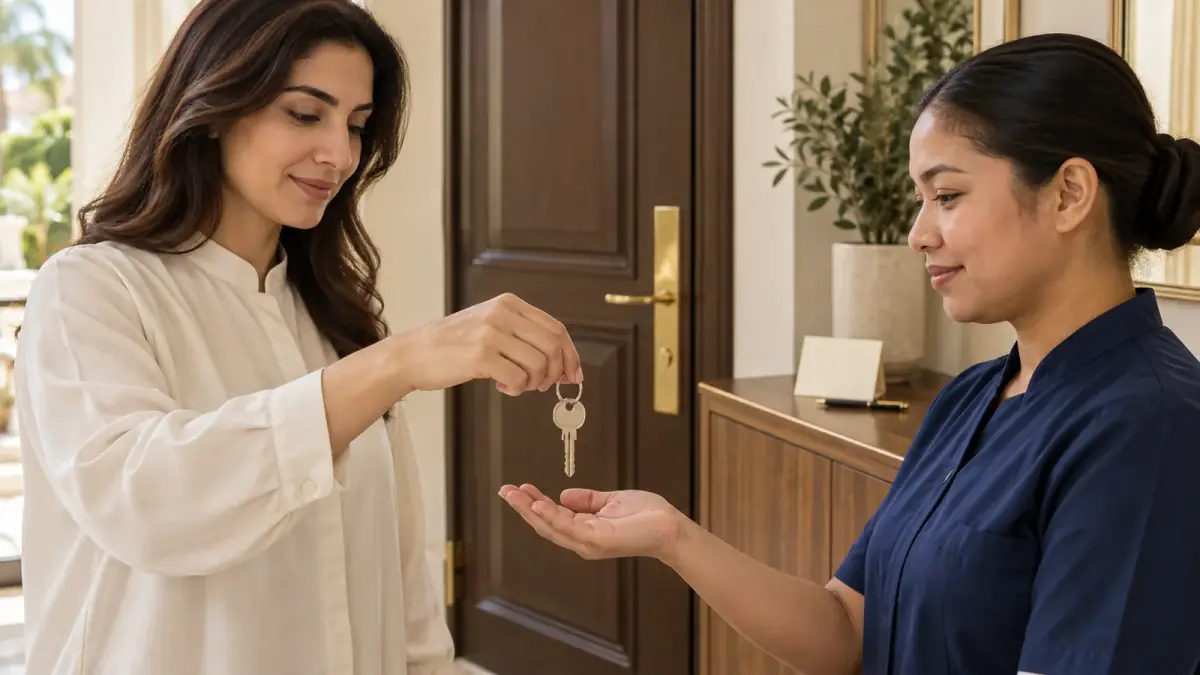
Agree home access before the first visit: who opens the door, which areas the worker needs, how keys are recorded and who handles a problem. A simple written arrangement protects the household and the worker from misunderstandings. Access should follow the agreed work, rather than giving someone responsibility for every room, visitor or security decision in the home.
Define
Name the work areas, restrictions and arrival contact.
Record
Log the key, card or limited access arrangement privately.
Handover
Review access changes at arrival and departure.
Close
Check returns and review permissions when the assignment ends.
An original household planning sequence, to adapt to the agreed service and building procedure.
Match access to the actual household duties
Walk through the route from the building entrance to the work areas. Explain reception registration, parking or lift arrangements, restricted rooms and the agreed arrival window. Identify one family contact and one alternative who can make decisions when the first person is unavailable. A person who answers the door should know which worker is expected and which service has been arranged.
Use your agreed household duties as the starting point. A laundry assignment does not automatically require access to locked document storage. Childcare access needs its own parent instructions; a cleaner should not decide independently who may collect a child.
Keep a short key and access record
The following is an original household planning worksheet. Store the completed version privately; public messages and group chats are not suitable places for security codes.
| Access item | What to record privately | Handover check |
|---|---|---|
| Physical key or access card | Item description, person receiving it and date | Count items together at issue and return |
| Building or community entry | Approved arrival route and registration contact | Check the current building procedure |
| Temporary digital access | Authorised user and agreed access period | Review access when the assignment changes |
| Restricted room or cupboard | Clear boundary and who can authorise entry | Explain the boundary during orientation |
| Lost key or failed entry | Family contact and service coordinator | Report the problem promptly; record the action taken |
Do not attach the full home address to a key label. Avoid sharing a household account or master login when a more limited access arrangement is available. Keep personal banking, identity and medical records outside the work handover unless a particular task genuinely requires access and the responsible person has authorised it.
Make privacy expectations reciprocal and clear
Discuss family photographs, children's information, private correspondence and social-media boundaries respectfully. Explain that household information is for the agreed work, not for public sharing. The same courtesy applies to the worker's personal information and private belongings. Do not circulate copies of personal documents as a substitute for following the appropriate verification process.
The UAE domestic-workers framework addresses workplace privacy and employment duties. For cameras or recording systems, obtain advice for the actual setup before using them; this checklist does not provide permission to record private spaces. Keep surveillance decisions separate from ordinary key and entry instructions.
Use a calm arrival and departure handover
At arrival, identify the day's priorities, any occupied rooms and changes to access. At departure, review completed work, return arrangements and anything requiring a family decision. For recurring visits, update the written instructions instead of expecting each worker to infer a new routine from an old conversation.
- Record keys or cards issued and returned.
- Share only the information needed for the agreed tasks.
- Report a missing item or access problem through the named contact.
- Review permissions at the end of an assignment or after a change of worker.
Treat a discrepancy as something to establish with records and a respectful discussion. Avoid public accusations, photographs of identity documents or posting a worker's personal details online.
Prepare your INAYA access brief
Before contacting INAYA, prepare the emirate, building entry process, task list and whether a family member will be at home. Read the worker-verification guide for the separate question of identity and relevant experience. Use the UAE Government's domestic-worker guide for the employment background.
Contact INAYA to put the service scope and access arrangement together. Send operational instructions through the agreed contact channel and retain your own private copy of the handover record.
Customer questions and answers
Should I give my maid a house key?
Choose an access arrangement that fits the agreed work and your household routine. If a key or card is issued, record the item, recipient, date and return arrangement privately.
What should I do if the worker cannot enter the building?
Use the named family contact and building registration process. Resolve entry before asking the worker to wait or change the service schedule, and record any revised arrangement with the coordinator.
Can I post identity documents in a family group to identify the worker?
Use the agreed verification channel and share only what the authorised people need. Keep personal documents out of public posts and unnecessary group circulation.
What happens to access when the service ends?
Check the key/card return record, review temporary permissions and remove access no longer needed. Keep this separate from any employment, payment or official cancellation process.