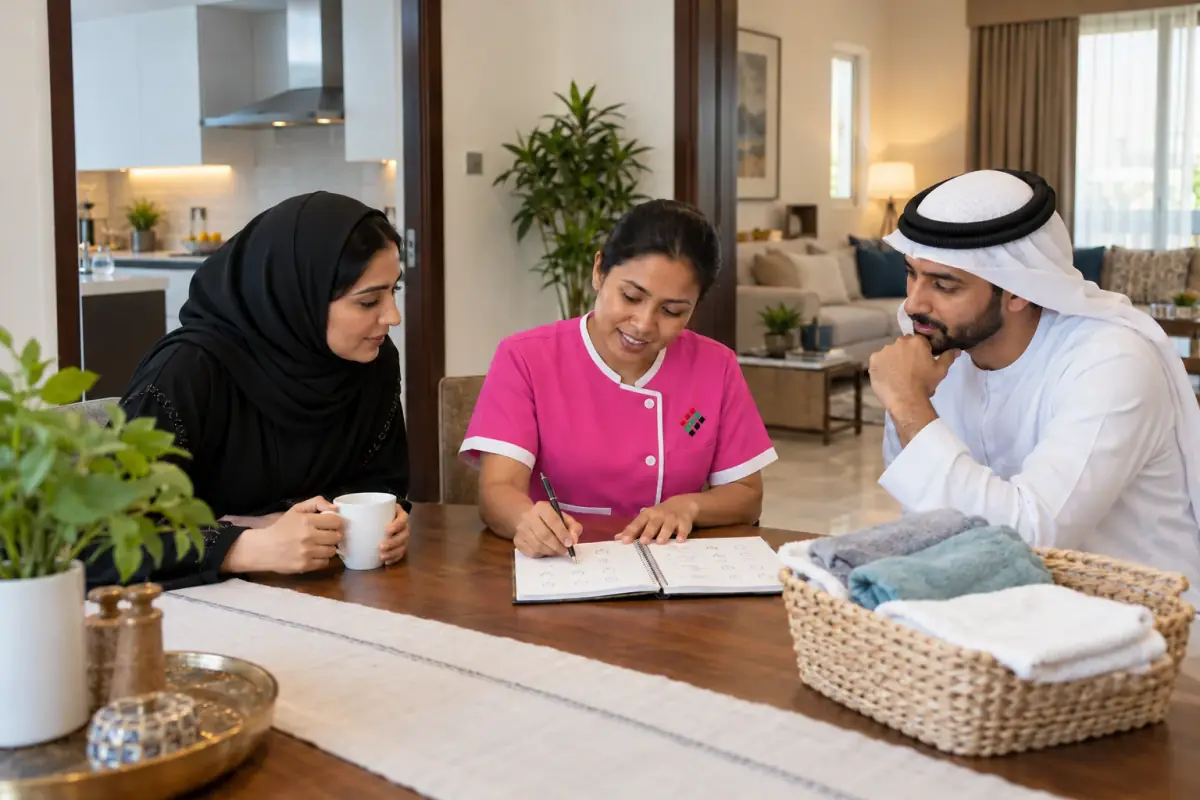
In everyday UAE usage, a domestic worker is someone engaged for agreed work supporting a private household or family. The term can cover different occupations; it does not mean that every person performs the same duties or is qualified for every household need. The actual occupation, employment arrangement and agreed scope matter.
Not every service performed at a private home is domestic-worker employment. A specialist service company or licensed healthcare provider may be supplying a different kind of service. Identify the actual employer, provider, records and applicable category; the place where work happens is not enough to decide the legal arrangement.
This introductory guide explains useful distinctions before you enquire. It uses relevant role examples, not a complete official occupation list. Use the specialised role, employment and licensing guidance for the person and arrangement under discussion.
Start with the work, not only the label
Describe what the household needs someone to do. Cleaning priorities, meal preparation, child supervision and personal driving require different conversations about experience, responsibility and instructions. A general request for a domestic worker leaves those questions unanswered.
Write the main task first and identify any secondary duties. Explain when tasks overlap and who can cover competing responsibilities. This gives the provider a realistic request to assess instead of assuming that one job title includes every service.
Understand relevant examples of domestic roles
MoHRE’s role examples reported by the UAE’s official news agency include housemaids, housekeepers, cooks, nannies or babysitters and personal drivers. The report is from January 2023; it provides background examples, not a newly verified complete occupation register for every current case. Confirm the actual category and record applicable to the proposed person. WAM: MoHRE domestic-occupation examples
| Common enquiry | Useful tasks to describe | What the label does not establish |
|---|---|---|
| Housemaid or housekeeper | Cleaning, laundry or agreed household organisation | Unlimited duties or suitability for all childcare needs |
| Nanny or babysitter | Children’s ages, supervision, routine and handover | A clinical qualification or inclusion of every household task |
| Domestic cook | The household’s meals, kitchen routine and equipment | Experience with every cuisine or a specialist medical role |
| Personal or family driver | The family’s journeys, schedule and related needs | Individual competence or the required permissions without review |
| Non-clinical caregiver enquiry | Companionship and agreed everyday support | Nursing authorisation or competence for clinical procedures |
The last row describes a common household-support enquiry. The table is a discussion aid, not a formal occupation list or a promise that INAYA has a particular person available. Review the individual role and case instead of selecting solely by the label.
After defining the role, use the rights and employer-duties overview to organise the responsibilities that need discussion.
Separate role, employment arrangement and accommodation
These terms answer different questions. Nanny describes the work focus; live-in describes where someone lives. A monthly plan describes a commercial service period. None of those phrases, alone, identifies the legal employer or all the working conditions.
| Term or record | Main question | What to confirm separately |
|---|---|---|
| Role | What work is being discussed? | Individual suitability and agreed duties |
| Employment arrangement | Who employs the worker? | Relevant parties, responsibilities and official records |
| Live-in or live-out | Where will the worker live? | Accommodation, transport and the actual routine |
| Visit or contract plan | What service period is being discussed? | Agreed schedule, rest and commercial terms |
| Permit or residence record | Which official record is held? | Its purpose, conditions and the applicable next step |
Use the employment-arrangements guide for a fuller comparison. Avoid turning an accommodation choice into an assumption about sponsorship, unlimited working time or one universal package price.
Distinguish household duties from a different service
An enquiry about regular household cleaning is not necessarily the same as a specialist deep-cleaning or commercial-cleaning contract. Describe the condition of the home, the areas concerned, available equipment and the intended work. Ask what can actually be provided before relying on a broad cleaning label.
Likewise, a person recruited for ongoing household duties and a booked service visit may involve different selection, commercial and processing questions. The routine versus specialist-cleaning guide helps frame the enquiry; it does not establish that every kind of cleaning is offered by INAYA.
Do not combine competing responsibilities automatically
Child supervision, cooking and household cleaning can need attention at the same time. List the priorities and decide what must be done by someone else or at another time. A long list of skills is less useful than a realistic account of the work and the responsibility it involves.
Hypothetical example: A family needs a child supervised during the same period that a meal is cooked. It can discuss the primary role and arrange separate cover for the competing task instead of assuming one person can safely do both continuously. The example is a planning question, not a promise about a candidate’s abilities.
Read the maid, nanny and babysitter comparison and agreed-duties guide before confirming a combined role.
Keep non-clinical support separate from licensed healthcare
MOHAP has a professional licensing process for nursing and other medical professions involving licensed medical facilities. A domestic-worker profile or the word caregiver is not evidence that the person holds the relevant healthcare licence. MOHAP: nursing and medical professional licensing
Where the need involves clinical care, involve the treating healthcare professional and an appropriately licensed provider. Clarify the required professional scope and relevant regulator. Do not expand a household worker’s job merely because they have experience helping a relative or an overseas job title.
For ordinary non-clinical support, discuss the person’s needs, the proposed tasks and available individual evidence. The caregiver-versus-licensed-nurse guide explains the distinction. INAYA’s non-clinical household support is not presented as a licensed nursing or therapy service.
Check individual skills and evidence respectfully
Ask the proposed person to explain relevant experience in ordinary terms. For cooking, discuss the household’s meals and equipment. For childcare, discuss the children’s ages, the person’s actual responsibility and the handover. For communication, use the language and instructions the household will actually use.
| Information presented | A useful follow-up | Avoid assuming |
|---|---|---|
| A general role name | Which tasks did the person actually perform? | Every duty linked to the title was performed |
| Experience | How does it relate to this household’s work? | The same routine exists in every home |
| A course or certificate | Who issued it and what does it demonstrate? | It is a current professional licence |
| A language description | Can ordinary instructions and questions be understood? | Nationality establishes language or skill |
| A claimed specialist qualification | What evidence and authorised scope apply? | A profile statement proves regulated competence |
Review the skills and communication guide for a practical discussion. Do not infer ability from nationality or portray every candidate as having undergone an unverified set of checks.
Keep household terminology separate from official processing
After describing the work, identify who employs the worker and which existing records matter. The household’s preferred label should not be used to guess the relevant official application or permission. An application acknowledgement, an employment record and a residence result describe different things.
For a processing enquiry, use INAYA’s domestic-worker visa guide and the document-preparation guide. Confirm the actual action and category; do not treat an informal job description as approval to work in a different arrangement.
Choose the enquiry route that matches the need
| Household situation | Useful first enquiry | Existing INAYA information |
|---|---|---|
| You need to discuss a worker for ongoing duties | Role, arrangement, suitability and current availability | Recruitment service and hiring guidance |
| You want a household service visit | Location, priorities, intended duration and work | Housekeeping service and visit-planning guide |
| Childcare is the main need | Ages, routine, responsibilities and handover | Nanny or babysitting information |
| You already know the worker and need document support | Current case, action requested and relevant parties | Domestic-worker visa and document guidance |
| A specialised clinical task is the main need | The healthcare need and required professional scope | An appropriately licensed healthcare provider |
These routes help clarify the question. They do not confirm a booking, candidate, licence, processing outcome or service outside INAYA’s published scope. Ask the team which supported service fits before sending private documents.
Prepare a useful first enquiry and handover
An initial message can explain the emirate, primary duties, arrangement preferred, routine and important communication needs. Keep essential requirements separate from preferences. You do not need to place passports, medical records or sensitive household information into a public enquiry.
Planning example: “We are in Ajman and want to discuss household help focused on cleaning and laundry. Meal preparation is a secondary question. Please confirm which arrangement and individual experience can be considered and what information you need next.” This is a sample enquiry, not a quotation or confirmation of availability.
When the role is agreed, prepare a manageable handover: equipment, access, priorities, one household contact and a method for raising questions. Use the first-week checklist rather than assuming that a worker will know every household’s routine on arrival.
Questions about the meaning of domestic worker
Does the term mean housemaid only? No. It is broader than one household role. This guide gives relevant examples; verify the actual official category for the case rather than using it as a complete occupation register.
Are nanny and live-in the same kind of label? No. One concerns the work; the other concerns accommodation. The employment arrangement and schedule need separate confirmation.
Does a caregiver profile establish a nursing licence? No. Check the required healthcare professional scope and relevant current licence where clinical care is needed.
Can a monthly plan include every task? A contract period does not establish individual suitability or unlimited duties. Confirm the work, responsibilities and written scope.
Discuss the actual role with INAYA
INAYA Domestic Workers receives UAE enquiries through its single office at Grand Mall, Ground Floor, Al Rashidiya 3, Ajman. Service availability, the individual role and the proposed arrangement need confirmation. The website form sends an enquiry; it does not guarantee a suitable profile or confirm an official application.
Use the services overview, recruitment information or contact page for the next conversation. Explain the actual household need first so the team can route the enquiry and identify what must be reviewed.
Official references and their scope
- MoHRE domestic-occupation examples reported by WAM, 19 January 2023: relevant role examples; not a complete current occupation register or a fresh statement of every wage-payment rule.
- MOHAP: nursing and medical professional licensing, English PDF: professional licensing is a separate matter from a household-support job label.
References were reviewed on 29 October 2026. The examples and enquiry tables are introductory planning aids. Confirm the current occupation, permission and any professional licence relevant to the individual case.