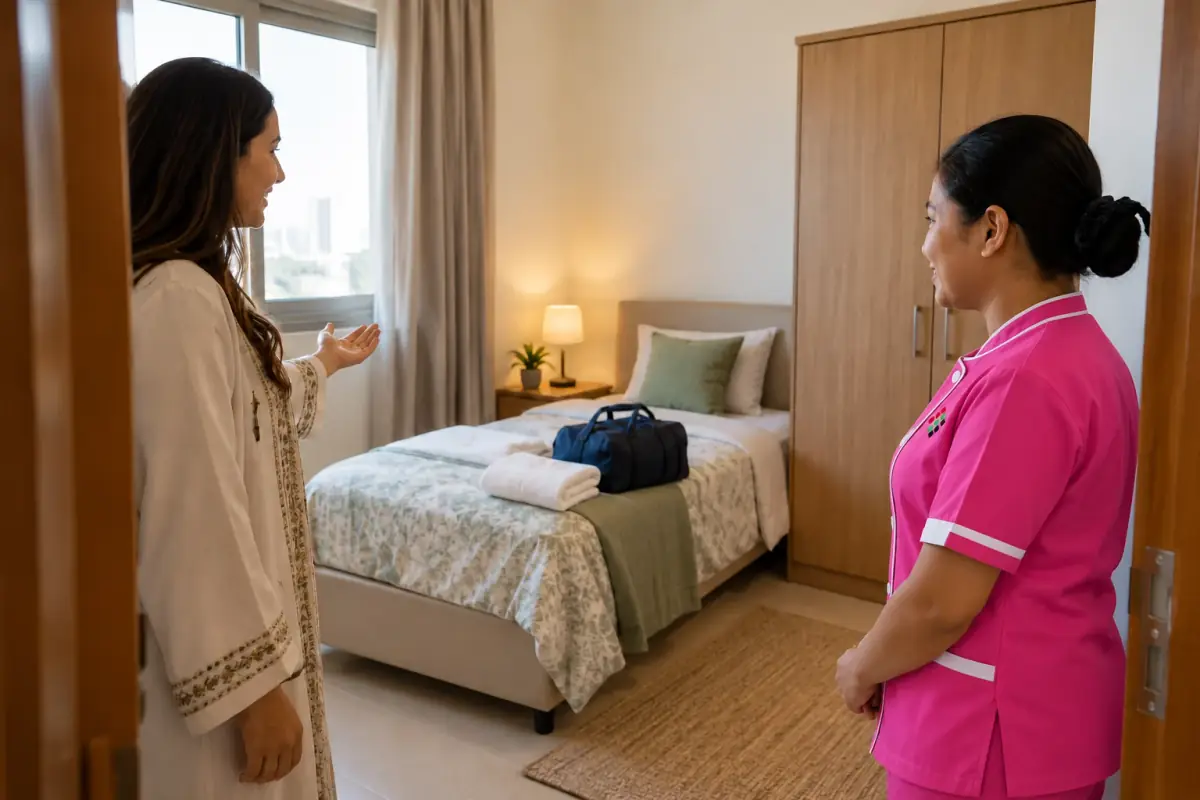
Prepare a live-in maid arrangement in Ajman by checking that the home, role and family handover are ready together. Suitable accommodation alone does not resolve duties, privacy, rest, meals or communication. Use this start-readiness walkthrough to identify what is prepared, what needs agreement and who will resolve it. The employment arrangements guide addresses the wider choice of arrangement; this article focuses on preparing a home before the agreed start.
Review the living space as a real daily environment
Walk through the proposed accommodation with everyday use in mind. Consider privacy, storage, access to practical facilities and how the household will respect the space. A room should not become an overflow cupboard that leaves a new worker uncertain where personal belongings can go. Raise any unresolved accommodation question before confirming the arrangement.
The UAE Government domestic-worker guidance addresses accommodation and employment responsibilities. Discuss the applicable terms with the service contact. This article's walkthrough is a planning aid, not an official property inspection or a substitute for the relevant requirements.
Use a home-readiness matrix
Mark each item “ready,” “needs agreement” or “not ready,” with a named person responsible. These are household planning labels, not a pass certificate. A practical problem is easier to solve before arrival than after someone has moved into an arrangement built on different assumptions.
| Readiness area | Preparation to discuss | Evidence of a clear arrangement |
|---|---|---|
| Accommodation | Proposed space, storage and practical facilities | Any questions resolved before start |
| Meals and household access | How meals and normal access are arranged | Written responsibilities for the actual arrangement |
| Personal privacy | Private space and appropriate household boundaries | Shared understanding of what is off limits |
| Work supplies | Suitable products, equipment and demonstrations | Named person supplies and explains them |
| Household routine | Main duties, fixed needs and flexible work | Short agreed role and priority plan |
| Communication | Main contact and method for raising a difficulty | Worker and household know whom to contact |
Avoid photographs of private spaces in a widely shared task sheet. If a practical question needs visual explanation, use an appropriate private conversation and limit sharing to what is necessary.
Separate residence from work coverage
Living in the home does not create continuous availability. Prepare the actual agreed working routine, rest and arrangements for absence rather than writing “available whenever needed.” A household that needs support during different periods must discuss those needs honestly and identify how gaps will be covered.
Place the family plan next to the worker's role plan. Which adult prepares for a late return? Who takes over if a time-sensitive family event conflicts with another duty? The wages, rest and leave guide is the established companion for those employment questions. The readiness walkthrough should make the discussion clearer without inventing new legal terms or changing the written agreement.
Introduce duties through places and demonstrations
Organise orientation around the home: laundry area, kitchen, supplies and any agreed care-related handover. Demonstrate an unfamiliar appliance rather than assuming that a similar-looking model operates in the same way. Explain the desired result, safe stopping point and person to ask if something appears wrong.
Start with essential routines and add less urgent details after a review. A large instruction folder can be useful for reference, but it should not replace a manageable first conversation. The first-week orientation checklist develops this stage, while the household duties guide helps with meaningful role changes.
Resolve the family's handover responsibilities
Several adults can unintentionally create competing instructions. Decide who coordinates changes and make sure other family members understand the arrangement. A guest's preference or a newly added task should not silently displace a fixed responsibility.
| Handover situation | Family responsibility | Clear instruction to agree |
|---|---|---|
| A new task arrives during another priority | Main contact decides what moves | State the replacement priority explicitly |
| The worker needs time to clarify a method | Demonstrate and invite questions | Explain one task without combining unrelated instructions |
| A private room or item is involved | Identify permission and boundaries | Ask before entering or handling restricted items |
| An appliance or supply seems unsafe | Arrange an appropriate response | Stop use and contact the named adult |
| Household plans change | Communicate the change promptly | Update timing and responsibilities together |
| A difficulty remains unresolved | Use the agreed service contact | Record the issue factually and request a next action |
For keys, access and sensitive information, consult INAYA's home-access and privacy guide. Do not put passwords, personal documents or access codes on a general worksheet.
Walk through a fictional start-readiness example
Fictional planning example: An Ajman household has prepared a sleeping space and assumes it is ready for a live-in arrangement. During the walkthrough, it notices that two adults expect to give instructions, laundry supplies are incomplete and nobody has planned coverage during the agreed rest period.
The family resolves the contact role, obtains the appropriate supplies and records how the family will cover the gap. It asks INAYA to clarify the actual arrangement before confirming the start. This example does not certify accommodation, promise an available worker or describe a real customer outcome. It shows why readiness includes responsibilities as well as a room.
Use a start conversation rather than a silent checklist
- Review the proposed living space and practical needs
- Clarify the agreed role and rest coverage
- Prepare supplies and a manageable orientation
- Resolve open questions with the appropriate contact
- Confirm the start and review the handover together
Original editorial planning tool; not an official mandatory process or a guaranteed outcome.
Invite the worker to ask about the home and explain any practical difficulty with the routine. If a method is unfamiliar, decide how it will be demonstrated. If a duty goes beyond the agreed role, discuss it through the appropriate service arrangement instead of treating arrival as consent to every request.
Record material agreements in a short handover note. Separate the working routine from personal family preferences that can be introduced gradually. An orientation discussion should reduce uncertainty; it should not pressure someone to say they understand a large amount of information immediately.
See how the readiness areas depend on one another
- FromAccommodation and privacySupports everyday livingToAgreed household routine
- FromSuitable supplies and methodsEnables agreed tasksToAgreed household routine
- FromFamily coverage during absencePrevents assumed continuous availabilityToAgreed household routine
- FromMain household contactCoordinates changesToAgreed household routine
- FromAgreed household routineProvides the initial planToWorker and household review
- FromWorker and household reviewRaises practical questionsToMain household contact
Editorial relationship map showing which records inform the household decision.
Accommodation, work supplies, privacy and family coverage support the agreed routine. None operates independently. A worker cannot follow an instruction that requires missing equipment, and a family cannot resolve competing demands simply by writing a longer duty list.
Review INAYA's live-in service and the relevant published package information. Confirm final payable costs, accommodation, meals, transport and supplies in the actual written scope. A published live-in/live-out price being the same does not settle every associated responsibility or make all household needs identical.
Frequently asked questions
Does live-in mean availability at all times, including overnight? No. Living in the home does not create unlimited availability. Discuss the actual duties, working and rest periods, and any requested support in the applicable written arrangement.
Must every household method be taught on day one? Prioritise essential routines, then introduce other details gradually. Demonstration and a two-way review are more useful than a long one-way speech.
Who should handle conflicting instructions? Name one household contact to coordinate changes. Other adults should know that a new priority needs an explicit decision about what moves.
Can the readiness matrix replace a contract? No. It is an editorial household tool. Confirm the actual arrangement and responsibilities in the appropriate written records.
Confirm the remaining questions with INAYA
Use INAYA's contact page to discuss the role, accommodation, schedule and anything marked unresolved. Bring a concise question list rather than private household records. Agree the next action before treating a preferred date as a confirmed start, then use the matrix for a respectful, practical handover.