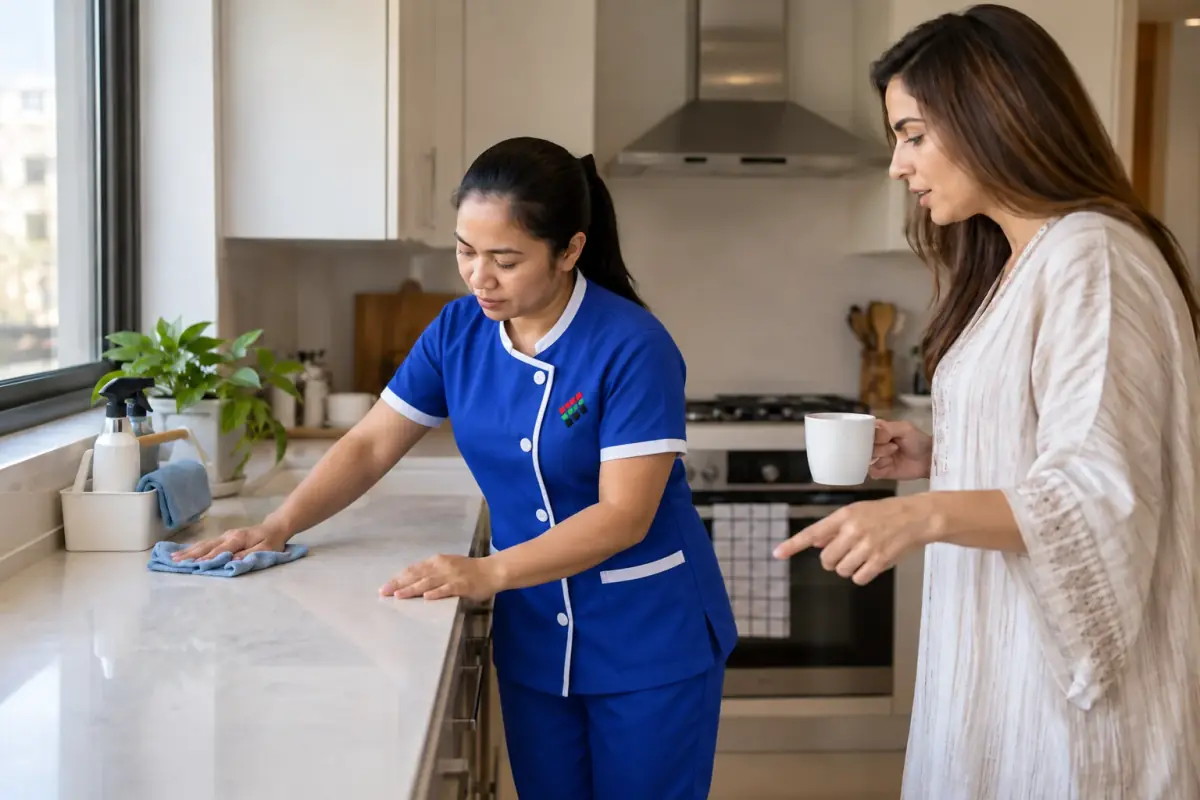
For a part-time maid enquiry in Ajman, choose the work that matters most within the booked visit and agree what can wait. INAYA publishes a four-hour package at AED 120 and an eight-hour package at AED 200. Neither duration promises that every room, load of laundry and extra request will be completed; workload, conditions and agreed duties still matter.
This article introduces a priority ladder and carry-over note. It complements the existing four-hour and eight-hour visit planner, which helps describe the visit itself. The additional decision here is how the household and worker respond when the requested list exceeds the available time or an unexpected task changes the plan.
1. Separate essential results from an open-ended task list
Begin with the reason for the booking. “Prepare the kitchen and main bathroom for normal household use” gives a clearer priority than “clean everything.” Identify the areas, current condition and any practical restrictions. Tell the team if the home has unusual access, pets or items that require special care.
Rank tasks as essential, useful if time permits and deferred. These are planning categories, not promises about speed. Several small requests can still become a large workload, particularly when equipment is missing or laundry must wait for a machine cycle. Do not treat a tidy appearance as evidence that every task takes the same time in every home.
2. Build a realistic priority ladder
| Priority | Household example | Decision before the visit |
|---|---|---|
| First agreed outcome | Ordinary cleaning of the main bathroom | Identify surfaces, supplies and any exclusions |
| Second agreed outcome | Kitchen work surfaces and agreed floor area | Clear personal items and explain product preferences |
| Useful if time remains | Folding one prepared laundry batch | Define the batch rather than “all laundry” |
| Requires clarification | Delicate item or unfamiliar appliance | Pause until instructions and suitability are clear |
| Outside this visit | Specialist treatment or work needing other equipment | Seek the appropriate provider or a separate scope |
Choose an order together rather than assigning hidden priorities after the work begins. If a task is essential before a particular household activity, say so in the enquiry. The team still needs to confirm whether the proposed visit can reasonably address it.
3. Compare four and eight hours without inventing capacity
The shorter and longer packages establish visit duration, not a standard number of rooms or a guaranteed production rate. Review the current part-time service page and pricing before requesting a quotation. Confirm the final payable amount, applicable tax, duties and booking-specific transport arrangements.
An eight-hour booking may allow a broader agreed plan, but a longer duration does not make unsafe or specialist work appropriate. Avoid multiplying tasks automatically by two. Travel and access arrangements, rest and the particular scope belong in the written confirmation rather than assumptions derived from the package name.
4. Prepare the home so the agreed work can begin
Put suitable products and equipment where agreed, explain appliances and identify areas that should remain private. Keep medicines, personal papers and valuables away from the working area. Do not hand over unrelated private information merely because someone needs access to a room.
A missing tool should lead to a decision about an alternative task, not improvised chemical mixing or unsafe equipment use. Follow manufacturer instructions. INAYA’s supplies preparation guide helps organise the practical discussion, while the home access and privacy guide addresses entry and key responsibilities.
5. Use an agreed change process during the visit
- Describe the home and main outcome
- Rank essential and optional tasks
- Confirm duration, scope and access
- Prepare agreed supplies and instructions
- Trade off any additional request
- Record completed work and carry-over
An editorial household workflow. Any change to duration, scope or booking requires confirmation.
This is an editorial visit-planning sequence, not an official service standard or a guarantee that the entire list fits. If the household adds a task, decide what moves down the ladder. Asking for an additional room without changing priorities can make the original outcome harder to achieve.
Use one household contact to resolve competing directions. If that person is unavailable, follow the agreed priorities and leave the uncertain task for clarification. A worker should not have to guess which relative’s last-minute instruction overrides the written plan.
6. Record carry-over without turning it into blame
An unfinished task needs a reason and a next decision. The record should distinguish work not reached because of priorities from a missing item, an access problem or a concern about the service. This makes the next booking more accurate and helps INAYA review a genuine difficulty.
| End-of-visit note | What it means | Appropriate next action |
|---|---|---|
| Not reached after priority work | The list exceeded this visit’s practical scope | Reorder the next list or review visit length |
| Awaiting household decision | Instructions or permission were unclear | Obtain clarification before scheduling the task |
| Equipment unavailable | The required suitable item was missing | Agree who supplies it for a future visit |
| Added during the visit | The original plan changed | Record the substituted task and remaining work |
| Service concern | A specific agreed outcome needs review | Contact INAYA with factual details |
Carry-over is not automatically permission to extend working time or charge a new fee. Confirm any additional booking through the agreed channel. If the household’s needs consistently exceed a short visit, revisit the arrangement instead of repeating an impossible list.
7. Understand the task, time and access relationship
- FromTask briefSets the outcomes to rankToAgreed priority ladder
- FromBooked durationLimits the planned scopeToAgreed priority ladder
- FromSuitable supplies and accessDetermines whether tasks can proceedToAgreed priority ladder
- FromAgreed priority ladderExplains completed and deferred workToEnd-of-visit record
- FromEnd-of-visit recordImproves the next visit enquiryToTask brief
Practical dependencies connect time, equipment, priorities and the next booking.
The graph shows why a duration alone cannot settle the result. The task brief defines the work; equipment and access affect whether it can proceed; priorities determine which outcome comes first. The end-of-visit record then improves the next brief instead of becoming a claim that every future visit will be identical.
Keep the lawful service arrangement separate from practical planning. A person’s residence status alone should not be treated as authorisation for your proposed booking. Use INAYA’s own-visa and part-time guide and the UAE Government domestic-worker reference for the relevant background, and confirm the actual arrangement before work starts.
8. A fictional Ajman visit example
Fictional planning example: A household books a four-hour visit and lists kitchen cleaning first, the main bathroom second and ironing as optional. On arrival, it adds guest-room preparation. The family contact chooses to replace optional ironing with the guest room, rather than expecting all work to be added without discussion.
At the end, the note records “ironing deferred by revised priority.” The next visit begins with a fresh list. This is a planning example, not a claim about how many rooms INAYA completes in four hours or evidence that a particular booking is available.
9. Frequently asked questions
How many rooms does a four-hour visit cover?
There is no universal room count in this guide. Describe the size, condition and tasks so the team can discuss a realistic scope rather than relying on a room-count promise.
Can I extend the visit if tasks remain?
Ask through the agreed booking contact. Availability, timing and any revised charge need confirmation; unfinished work does not itself authorise an extension.
Is deep cleaning included in a normal maid visit?
Do not assume it is. Explain the task and equipment needed. Specialist deep cleaning, hazardous work or treatment services require the appropriate provider and scope.
What if I need help every week?
Use the carry-over notes to identify recurring needs, then discuss visit frequency or another arrangement. Regular visits still need agreed duties, dates and availability confirmation.
10. Send an enquiry that can be assessed
Share your Ajman area, preferred four- or eight-hour option, first two priorities and access requirements through INAYA contact. Ask which supplies and transport arrangements apply. The useful outcome is a clear confirmed visit, rather than an unlimited list attached to a package price.